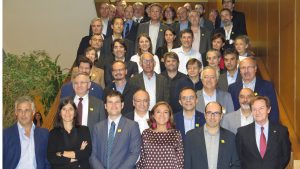
Department of Economics in the Top 50 of Ranking QS

The Department of Economics enters again in the Top 50 of ranking QS  in the subject “Economics and Econometrics”.

The ranking QS analyzes four indicators: reputation, the academic institution’s reputation among academics, the reputation among employers, the number of citations and the so-called h index, which measures the quality of researchers according to the number of citations their articles have received. This classification, therefore, prioritizes the research of the universities.

Together with Economy, another 22 Spanish faculties – belonging to 12 Universities – join, reaching the top 50 in their respective areas. The Department of Library Science and Documentation of UC3M has also managed to sneak into position 38 in its specialty.

Source: El Mundo, El País, La Vanguardia
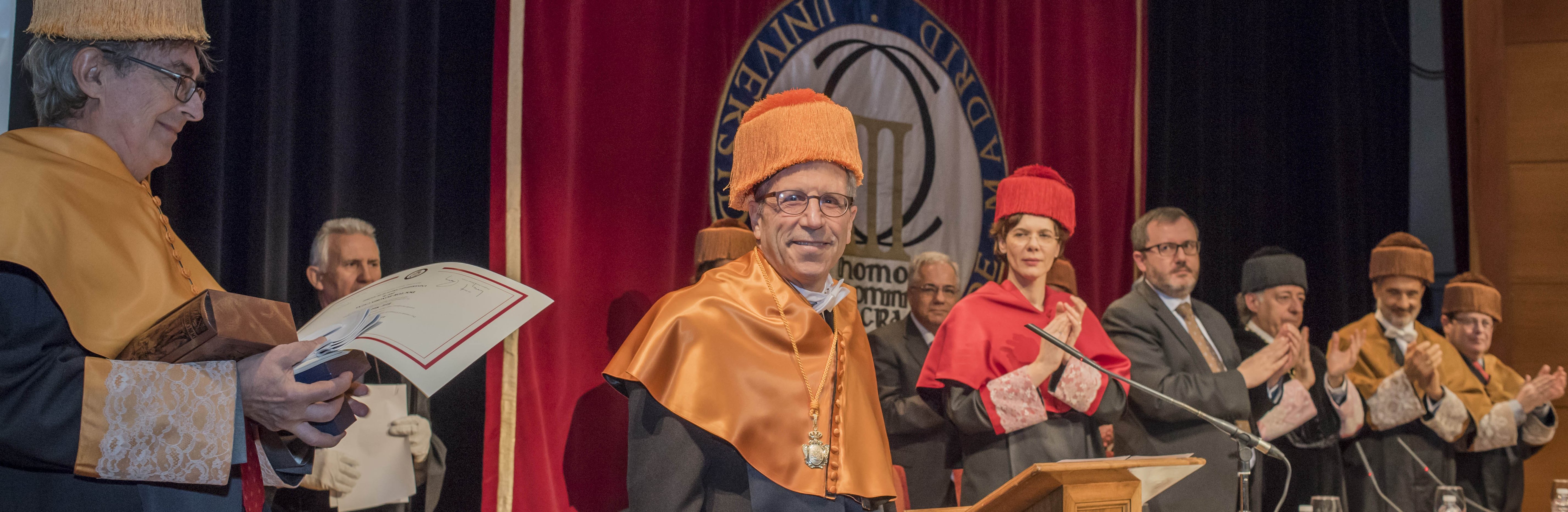
Eric Maskin, Doctor Honoris Causa


Carlos III University of Madrid (UC3M) has awarded as Doctor Honoris Causa to Professor Eric S. Maskin of Harvard University and Nobel Laureate in Economics, in recognition of his outstanding scientific and academic merits.

At the ceremony held on February 16 at the Getafe campus, which also has been invested Professor Anant Agarwal and more than 35 new doctors and doctors of UC3M. The laudatio of Eric S. Maskin has been made by Professor Luis Corchón, of the Department of Economics of UC3M.

Eric S. Maskin (New York, 1950) is Professor of Economics at Harvard University (USA). PhD in Applied Mathematics from that university, he has been a researcher at the University of Cambridge and a professor at the Institute of Advanced Studies at Princeton and at the Massachusetts Institute of Technology. In his works he has made outstanding contributions to political economy, contract theory and game theory, among other fields. In 2007 he received the Nobel Prize in Economics (along with Leonid Hurwicz and Roger Myerson) for laying the foundations of the theory of mechanism design. “This theory is in its infancy, but still has produced important applications: to auctions such as the radio spectrum, to the theory of pairing (which has designed efficient mechanisms for organ transplantation and the allocation of students to schools), to the design of mechanisms against pollution, to the distribution of food for the poor and, finally, its application to the design of cryptocurrencies is being considered”, says Professor Luis Corchón.


Ir a la fuente de la noticia